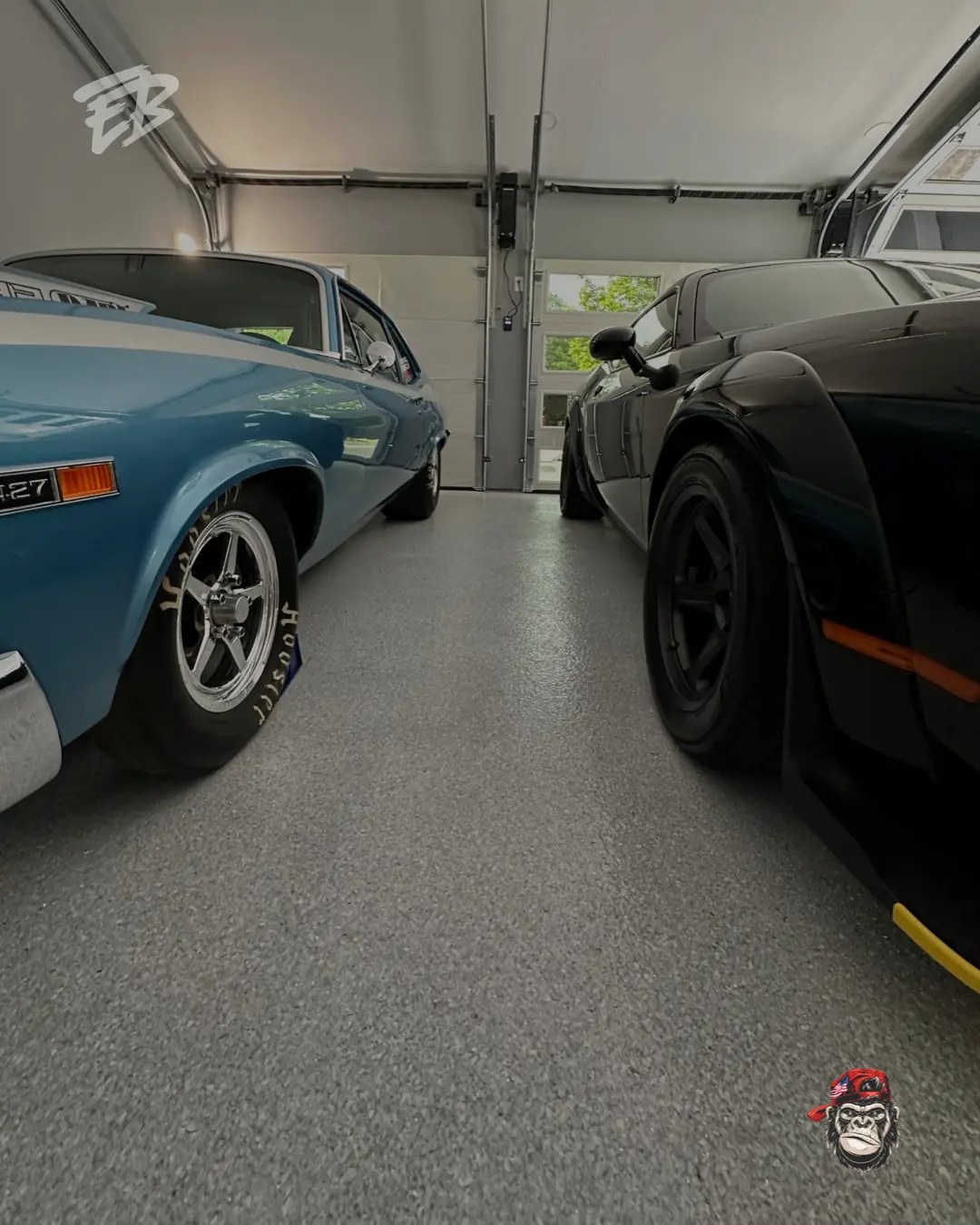
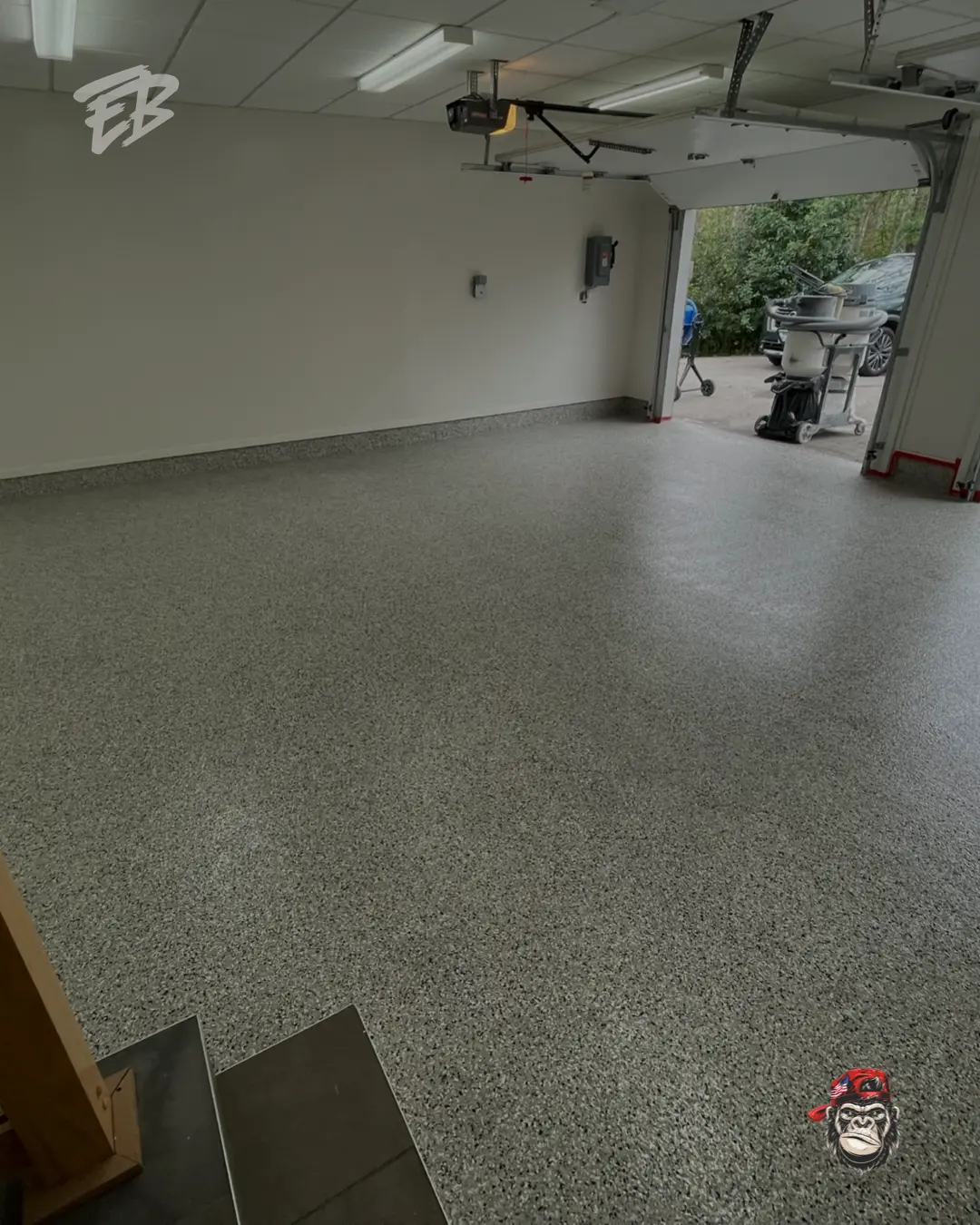
For most South Florida garages, a polyaspartic topcoat is worth it, and for many, a full polyaspartic system is the best fit. Polyaspartic coatings are UV-stable, so they resist the yellowing that sunlight causes in many epoxies at the garage door line, and they cure fast, so installations take less time. Their limits are a short working time and sensitivity to moisture and humidity, which makes preparation and an experienced crew essential. This guide explains how polyaspartic performs in Miami-Dade, Broward and Palm Beach garages and what real Epoxy Boss Florida projects used.
What polyaspartic is
Polyaspartics are two-part aliphatic coatings from the polyurea family, formulated to react slowly enough to be rolled and squeegeed on a floor. In a garage they are used as the clear topcoat over a flake or solid base, or for every layer of the system. See polyaspartic materials.
Why it suits South Florida garages
Sun at the door line
When the overhead door is open, strong sunlight reaches the front of the floor. Many epoxies yellow or chalk under UV light. Aliphatic polyaspartic topcoats hold their color much better, which is why they are the usual wearing layer on Florida garage floors. See UV-stable floor coatings.
Heat and hot tires
A good polyaspartic topcoat holds up well to tire traffic, grit and common garage fluids. Bond still depends on preparation: a coating on unground concrete can lift under hot tires, whatever the product.
Fast installation
Fast cure means base, flake and topcoat can often be installed in a short schedule, which is easier on homeowners who need the garage back quickly. See fast-cure flooring systems.
The limits to plan for
- Moisture: many South Florida slabs sit on a high water table, and moisture moving up through the concrete can cause blistering under a coating. Testing and a moisture-mitigation primer are used where needed. See moisture and substrate systems.
- Humidity and heat during application: both speed up the cure and shorten working time, so the crew mixes small batches and plans the day around conditions.
- Thin films: polyaspartic is applied thinner than high-build epoxy, so it does not level an uneven slab on its own; repairs and grinding do that.
Full polyaspartic or epoxy base with polyaspartic top?
Both are common, and the choice depends on the slab and the schedule:
- Full polyaspartic system: polyaspartic base, full flake broadcast and polyaspartic topcoat. Fastest to install and UV-stable throughout.
- Epoxy or hybrid base with polyaspartic topcoat: the base adds build and adhesion; the polyaspartic topcoat adds UV stability and wear resistance.
Real projects show both approaches:
- Davie, 500 sq ft: a full polyaspartic flake system, chosen for its fast cure and UV stability. The slab was mechanically ground, minor defects were repaired, then a polyaspartic base, full flake broadcast and polyaspartic topcoat were applied. See the Davie polyaspartic garage.
- Davie, 1,600 sq ft near Griffin Road: multiple cracks were opened and repaired with industrial-grade polyurea, then a polyurea/polyaspartic base, full flake broadcast and polyaspartic topcoat were installed, with the entry step coated as part of the system. See the Davie full-flake garage.
- Boca Raton, 2,362 sq ft new slab: a slab assessment with moisture testing where required, diamond grinding, a compatible base coat, full flake broadcast and a clear polyaspartic topcoat. See the Boca Raton garage floor.
How a polyaspartic garage floor is installed
- Assessment: slab condition, cracks, old coatings and moisture are checked.
- Diamond grinding: the surface is opened so the coating can bond. See diamond grinding.
- Repairs: cracks and chips are filled and ground flush. See crack repair.
- Base coat and flake: flake is broadcast to full coverage, then scraped and vacuumed.
- Polyaspartic topcoat: seals the floor and becomes the wearing surface.
- Return to use: foot and vehicle traffic times follow the product data sheet and the day's conditions.
Questions to ask before you choose
- Is the topcoat a true aliphatic polyaspartic, and can I see the data sheet?
- Is the floor diamond ground, not just cleaned or etched?
- Is moisture testing included, and what happens if moisture is high?
- Which product is used for the base coat?
- When can I park on the floor?
Frequently asked questions
Is polyaspartic better than epoxy for a Florida garage?
As a topcoat, usually yes, because of UV stability at the door line. Epoxy can still be a good primer or base. The best systems use each where it performs best.
How long until I can drive on it?
Foot traffic is often possible within hours. Vehicles wait for the cure time on the product data sheet, which we confirm in your quote.
Does a polyaspartic floor get slippery?
A flake broadcast adds texture, and fine aluminum oxide can be added to the topcoat for extra grip where needed.
How much does it cost?
It depends on size, slab condition and the system. See our garage floor coating cost guide or get a range from the garage floor calculator.
Get your written quote
Epoxy Boss Florida installs garage floors across Miami-Dade, Broward and Palm Beach from our base in Dania Beach, including Miami, Fort Lauderdale and Boca Raton. Call (954) 288-2459 or request a free floor assessment for a written quote in US dollars.