Factory & Manufacture
Thank you! Your submission has been received!
Oops! Something went wrong while submitting the form.

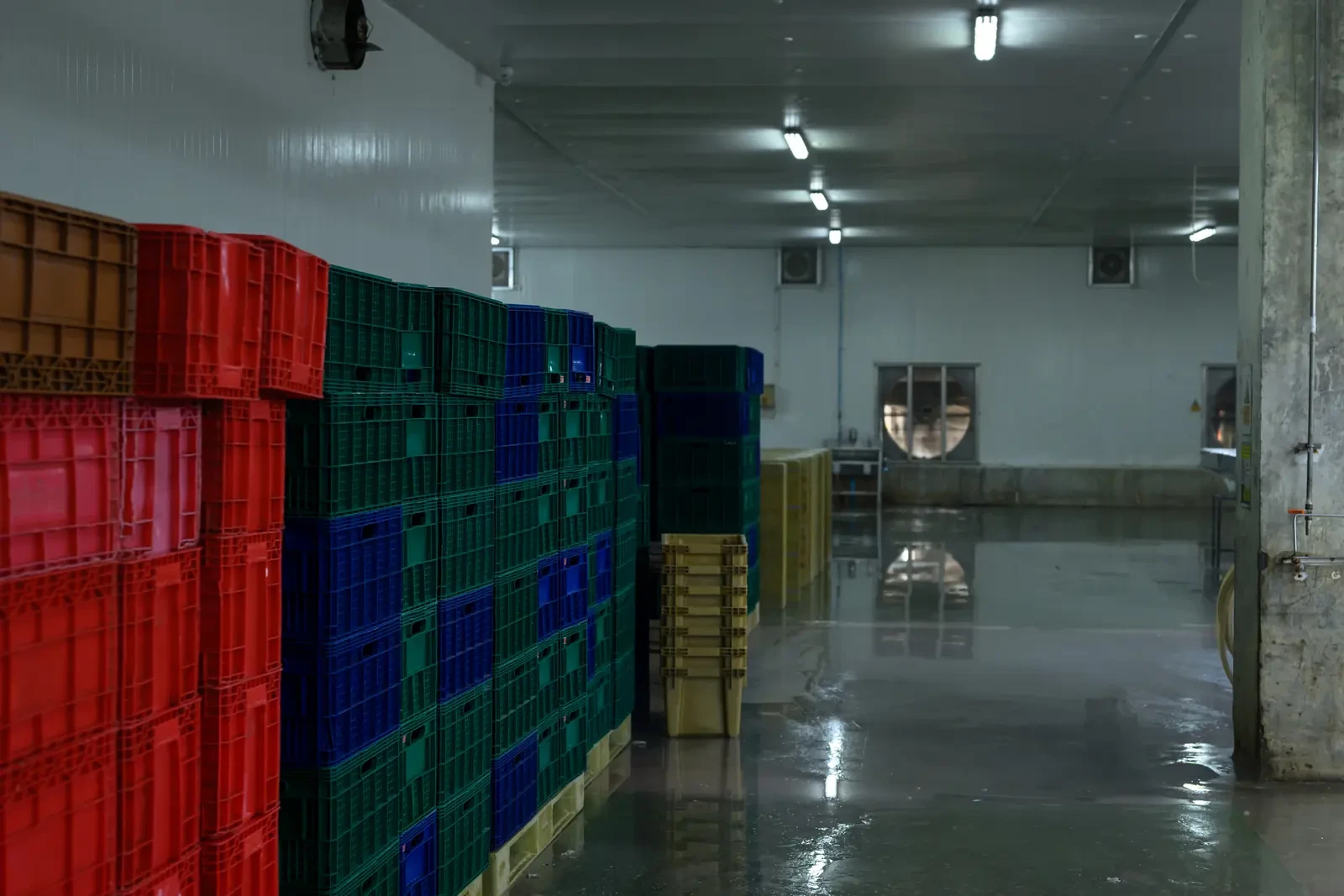

Production floors carry machinery, forklifts, dropped parts, cutting fluids and solvents. Damage tends to start at joints and around equipment bases, then spreads. The floor needs impact and abrasion resistance, chemical resistance matched to the process, safe traction and clear zone marking.
Common directions, part of our industrial flooring range:
Every coating is only as good as its bond to the slab. Before anything is applied, Epoxy Boss Florida checks the concrete for moisture, old coatings, contamination and damage, then opens the surface mechanically with diamond grinding or shot blasting. Old coatings, oil-soaked concrete and damaged joints are removed and repaired before any system is applied. We explain why we grind or blast instead of acid etching in this article.
Tell us what is produced, which chemicals reach the floor and when areas can be shut down. We will assess the slab and recommend a system. To begin, request an estimate.
Services commonly specified for factory and manufacturing floors. The final system is confirmed after we assess the concrete on site.
See all industrial flooring options.
Yes. A newer slab is usually in better condition, but the surface of fresh concrete is closed and a coating will not bond into it as it is.
Grinding opens the surface so the system anchors into the slab rather than sitting on top of it.
Usually yes. Age by itself is not the problem — moisture coming up through the slab is, and a lot of older houses here were built without a barrier underneath.
We check the slab before quoting. If the reading is high we put a barrier down first; if it is clean, nothing extra is needed.
No, it comes up constantly and we plan for it. With the garage door open the floor counts as something the neighbors see, so the board usually wants to sign off on the color first.
We bring physical samples you can submit and schedule the install once you have approval, so the floor is never done twice.
Usually yes. Stains and old patches sit at the surface, and grinding takes that layer off before anything is applied.
What we check for underneath is moisture and structural cracking, since those decide the build rather than the appearance.
Yes. Cracks, chipped edges and failed patches are repaired as part of the preparation, not treated as an extra afterwards.
A coating does not bridge a moving crack on its own, so the repair has to happen first if the finish is going to stay flat.
You can walk on it the next day. Vehicles need longer, because tires put far more stress on a fresh coating than feet do.
We give you the exact window before we start, so you can plan where the car goes in the meantime.
Yes, the floor has to be completely clear before we start — including shelving and anything fixed along the walls.
If moving heavy items is a problem, tell us when we quote and we will build it into the plan rather than leaving it to the morning of the job.
Summer pavement temperatures leave tires hot enough to soften a weakly bonded coating. As the car cools, the tire grips and pulls the coating off the slab, usually in a patch the shape of the tire.
It is almost always a preparation failure rather than a product failure, which is why we grind to a CSP-3 profile with planetary diamonds and never acid etch.
UV exposure. A garage with the door open takes hours of direct sun every day here, and standard epoxy is not UV-stable — it ambers and chalks within a couple of seasons.
The fix is in the topcoat: a UV-stable polyaspartic or aliphatic urethane finish holds color. This matters more on light greys and whites, where the shift is obvious.
Almost always one of two things. Either the slab was never tested for moisture and vapor lifted the coating from below, or the preparation was acid etching rather than mechanical grinding, so the coating never had a proper mechanical bond.
Both are preparation failures, not product failures — which is why replacing the coating without addressing the cause produces the same result again.
Four reasons, all local: moisture rising through slab-on-grade concrete near the water table, wet-season humidity that disrupts the cure, salt air and UV attacking the topcoat, and summer hot-tire pickup. None of them exist in the same combination inland, which is why a system specified for a northern garage underperforms here.
Residential floor coating generally does not require a building permit in South Florida. Condo buildings and HOA communities frequently have their own approval process, particularly for shared garages and balconies.
The old coating is normally ground off first. Coat over a failing bond and the failure repeats.
One to two days. Grinding, crack repair and the base coat on day one; the protective topcoat on day two. Longer if the slab needs moisture mitigation or significant concrete repair.
Yes. Polyaspartic systems are commonly installed in residential and commercial garages due to their resistance to hot tire transfer, vehicle traffic, humidity, abrasion and long-term UV exposure.
Epoxy flooring chemically bonds into the concrete substrate through mechanical preparation, creating a durable protective system. Standard paints primarily sit on the surface without providing the same adhesion strength or long-term durability.